
TL;DR: How to Add Pricing to WordPress.
SeedProd lets you build both a simple price list and a full pricing table on any page, no code needed.
Here’s the quick version:
- Install SeedProd – Download and activate the Pro plugin, then enter your license key.
- Decide which you need – A price list for services or menu items, a pricing table for tiered plans.
- Pick a template – Browse the library and import a design you like.
- Drag in your block – Add the Price List block or the Pricing Table block and fill in your details.
- Publish – Save and push your page live.
Each one takes about 10 minutes. I’ll walk you through both below.
When I first needed to show my rates on a WordPress site, I didn’t want to mess with shortcodes or clunky plugins. I just wanted something simple, clean, and easy to update.
If you’re in the same boat, you can build both without touching code. I’ll show you how to make a price list for services or menu items, and how to build a pricing table for tiered plans, both with SeedProd’s drag-and-drop builder.
Let’s start with which one fits your site.
Why Your Website Needs Pricing
Most shoppers check prices before they’re ready to buy. Showing your pricing helps them compare what you offer and feel confident about their decision.
It’s especially helpful for freelancers, salon owners, and local businesses where transparency builds trust.
Clear Pricing Improves the User Experience
If visitors can’t find your prices quickly, they’ll likely leave your site. Showing them clearly helps people decide faster, and helps lower your bounce rate.
Price List vs. Pricing Table: Which Do You Need?
These two get mixed up a lot, but they solve different problems. A quick look at each will tell you which one to build.
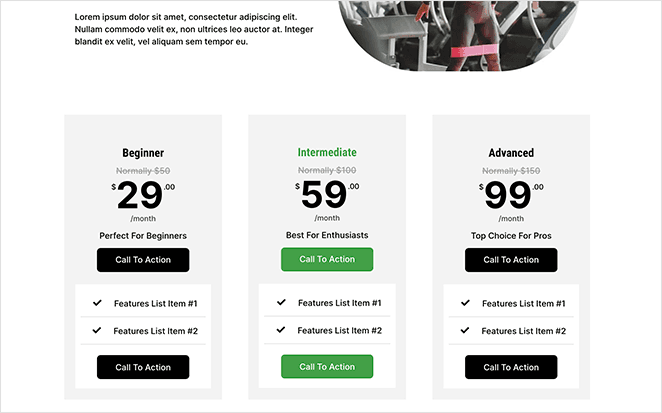
A pricing table shows multiple plans side by side, usually with a feature list and a button under each one. You’ll often see them on SaaS or membership sites.
A price list is simpler. It lists individual services or items with a price for each, which works better for restaurants, freelancers, or salons.
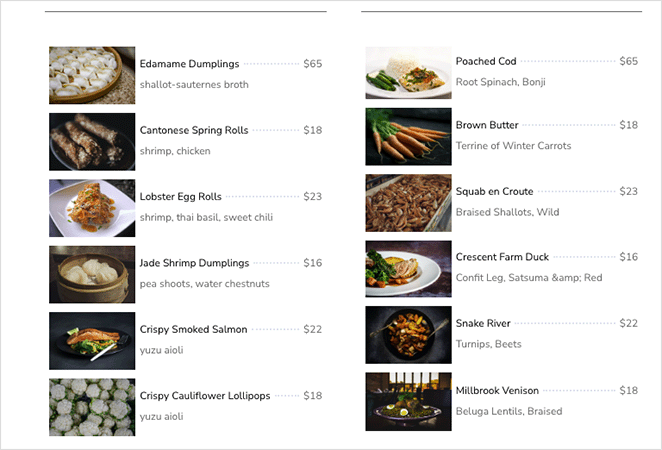
Here’s the short version. Use a price list for a single-service business, a menu, or a rate sheet where each entry stands on its own.
Use a pricing table when you offer tiers or packages and you want people to compare them at a glance. Either way, you can build it with the same tool, so you’re not locked into your choice.
For this guide, I’ll use a drag-and-drop builder because it’s the easiest way to get either layout looking the way you want, and SeedProd is the best solution on the market.

SeedProd is the most beginner-friendly drag-and-drop website builder for WordPress. Its interface makes creating custom page designs easy, with no coding needed.
It has a dedicated block for each job: a Price List block and a Pricing Table block. Both come with pre-made templates, so you can have a stylish result live in minutes.
Here’s what you get with SeedProd:
- Built-in Price List and Pricing Table blocks
- Premade template library
- WordPress theme builder
- Landing page builder
Follow the steps below to build whichever one you need.
- How to Make a Price List in WordPress
- Step 1. Install and Activate SeedProd
- Step 2. Choose The Theme or Landing Page Builder
- Step 3. Select a Custom Template
- Step 4. Customize Your Price List Page
- Step 5. Publish Your Price List Page
- How to Make a Pricing Table in WordPress
- Step 1. Add the Pricing Table Block
- Step 2. Customize Your Plans
- Step 3. Publish Your Pricing Table
- Frequently Asked Questions
How to Make a Price List in WordPress
A price list is the right choice when each service or item stands on its own. Let’s cover what to put in it, then build one step by step.
What Should a Price List Include?
A good price list covers four things: the item name, a short description, the price, and an optional photo. Some businesses also add a link to a product page or booking form, which works well for driving conversions from each entry.
Setting your rates takes a bit of research. I usually check competitor rate sheets to see what’s standard, then factor in my costs before deciding on a format.
A flat rate is clearest for most readers, but “starting from” pricing works when your service varies by scope. SeedProd’s Price List block handles all of these fields in one layout: title, description, price, image, and a link.
Step 1. Install and Activate SeedProd
The first step is to go to the SeedProd website and download the plugin. You can choose from several pricing plans to suit your budget, but I’m using the SeedProd Pro version for this tutorial.
Next, install and activate the plugin zip file on your WordPress website. You can follow this post on how to install a WordPress plugin if this is your first time doing this.
Upon activating the plugin, go to the SeedProd » Settings page and paste your license key. You can find your license key in your SeedProd account under the Downloads section.
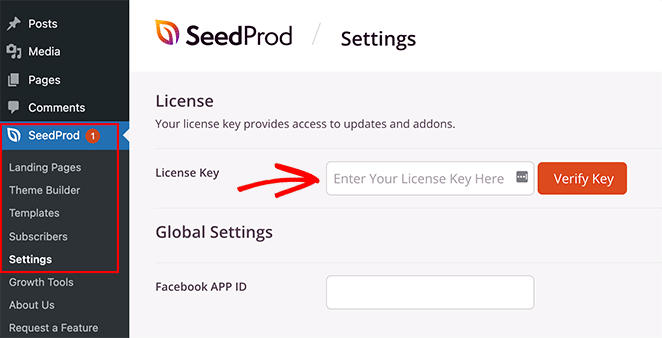
Now go ahead and click the Verify Key button.
Step 2. Choose The Theme or Landing Page Builder
There are several ways to customize your WordPress site with SeedProd’s drag-and-drop website builder.
You can replace your existing site design with a new one by building a custom WordPress theme. Or you can keep your current design and create a standalone pricing page with the Landing Page Builder.
Either way, you can still use SeedProd’s Price List block, because it uses the same page builder interface.
For this guide, I’ll choose the Theme Builder option, so navigate to SeedProd » Theme Builder and click the Theme Template Kits button.
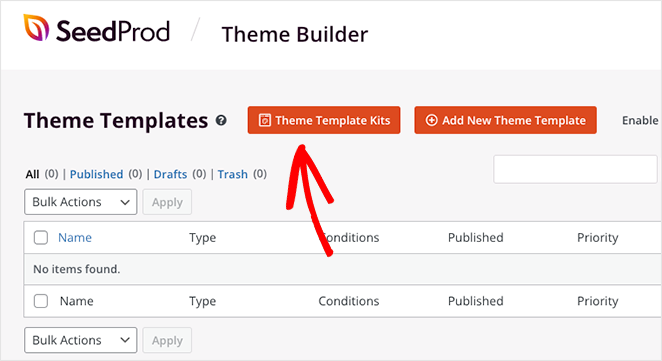
Step 3. Select a Custom Template
On the next screen, you’ll see SeedProd’s library of premade website templates. They include all the features and pages you need to create a complete website and a professional design that you can customize easily.
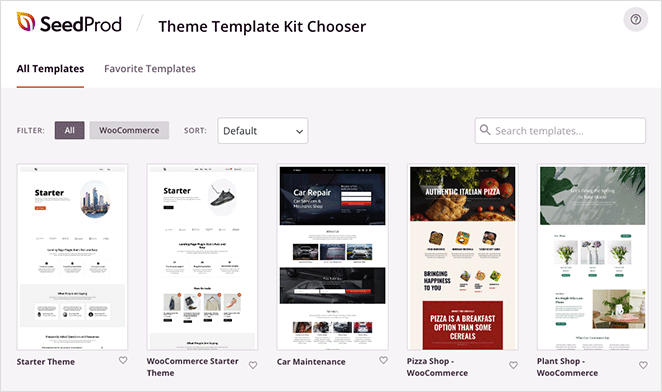
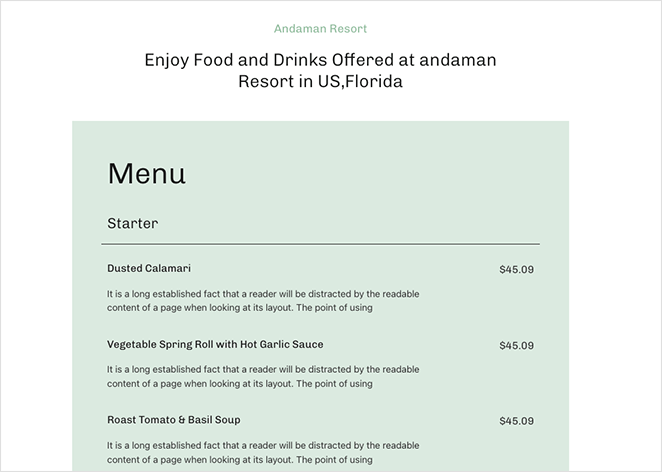
Click the magnifying glass icon on any template to preview the whole theme. For example, if you preview the Andaman Budget Hotel theme, you’ll see that the Dining page already has a simple price list that you can edit.
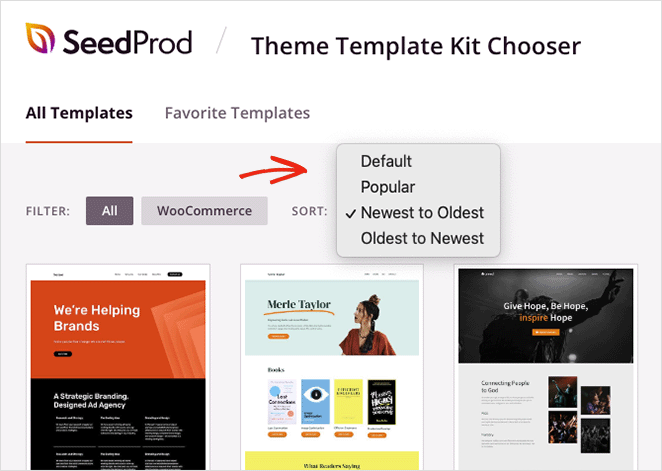
You can filter the template library to show only WooCommerce themes or click the dropdown menu to show the newest, oldest, or most popular themes first.
Once you find a design you like, click the checkmark icon to import it, which should take just a few seconds.

Now you’ll see the parts of your theme in the Theme Builder dashboard. You can edit any template by hovering over it and clicking the Edit Design link.
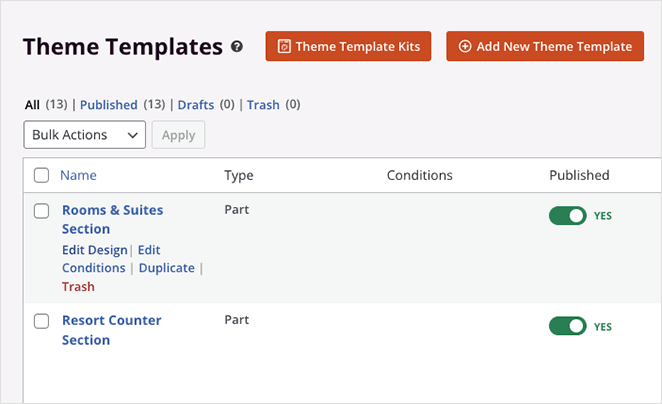
See our guide on creating a custom WordPress theme for more details on customizing your theme parts.
SeedProd will also create the pages from the theme demo for you to customize with its page builder. Simply go to Pages » All Pages, and you’ll see them in the list with “SeedProd” next to the page title.
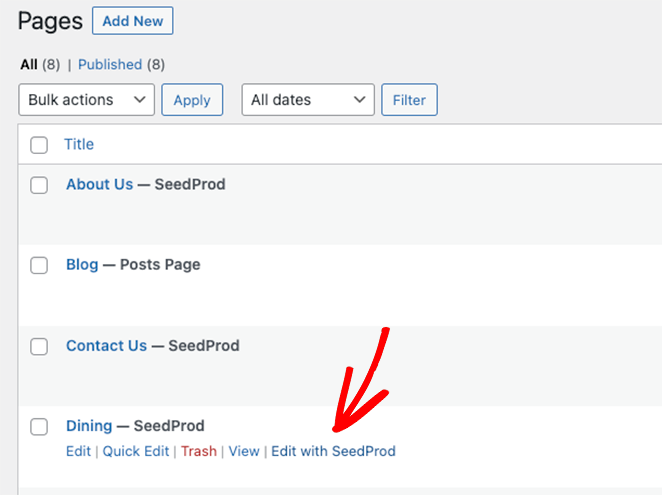
I’ll customize the “Dining” page to show you how to use SeedProd’s Price List feature. So hover over the page and click the Edit with SeedProd link.
Step 4. Customize Your Price List Page
When you open any page with SeedProd, you’ll see a layout like this:
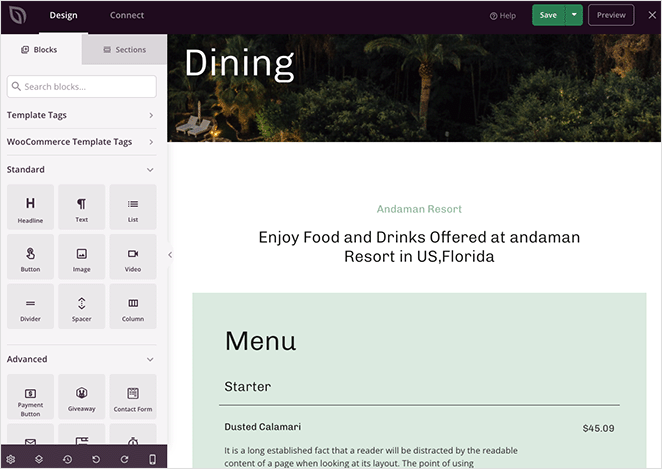
The page builder has WordPress blocks and settings on the left and a live preview of your design on the right. The blocks work like the WordPress block editor, so you drag new blocks onto your page and click to edit them in real time.
When you look at the menu on this design, you’ll see it’s made of headline and text blocks.
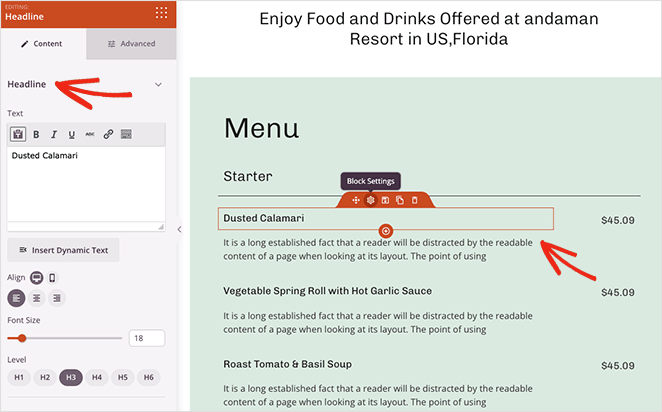
The Price List block is an easier way to display your menu items and their pricing. It automatically includes space for your item, description, price, and image, with plenty of customization options.
From the left-hand panel, scroll to the Advanced section, find the Price List block, and drag and drop it onto your page.
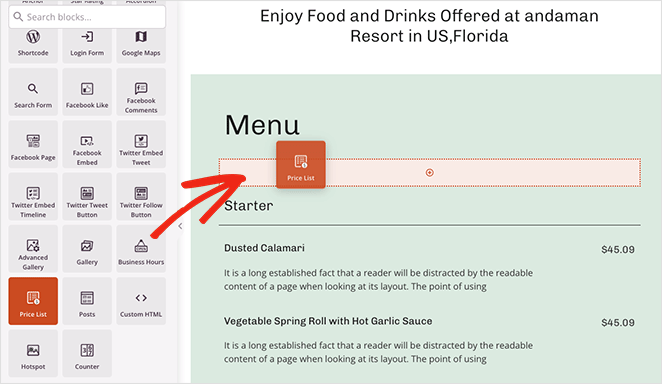
The block will add some filler content to give you an idea of how things will look. So let’s go ahead and add some price list items.
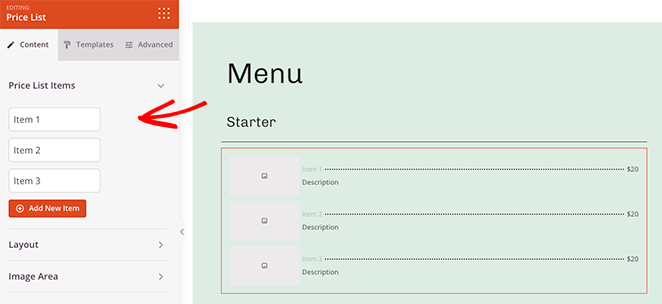
To do that, click the “Item 1” heading to expand it. Inside, you can add a title, description, and price, upload a photo, and even add a link to the individual product page.
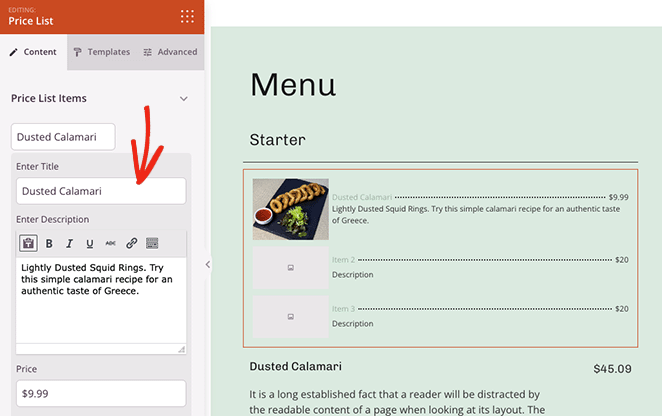
Repeat this step for every item on your price list.
After adding items to your price list, you can expand the Layout settings. In this panel, you can change the image and price position, choose a different price separator, and adjust the overall list alignment.
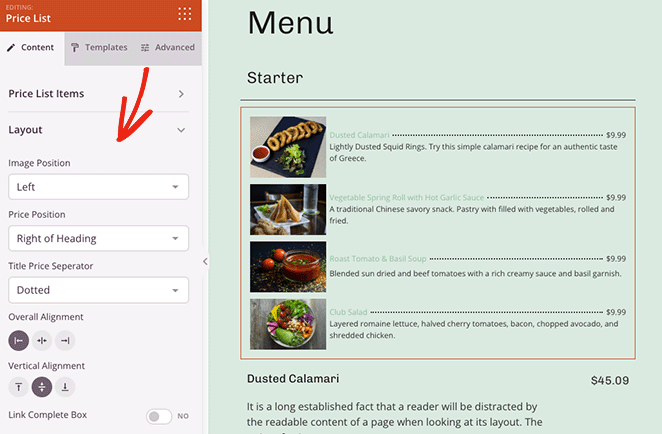
You can even link the full price box to the individual pricing page. Just click the toggle to the Yes position.
In the Image Area panel, you can control the size and shape of any images on your price list. The options include Default, Rounded, Circle, and Custom, where you can define your own image border-radius.
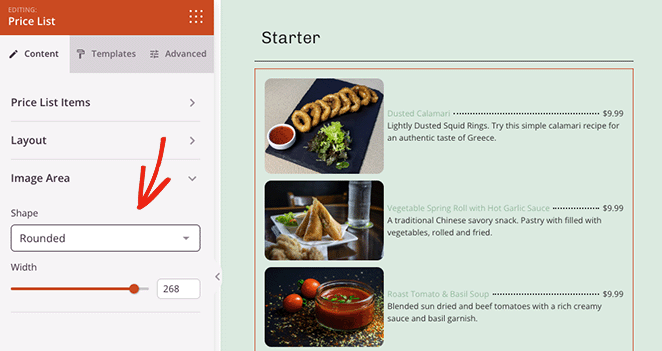
Now click the Advanced tab to see some extra styling options.
This panel lets you control the typography, font size, and colors of individual items on your list. The Price List block gives you full control over how your service pricing appears on screen.
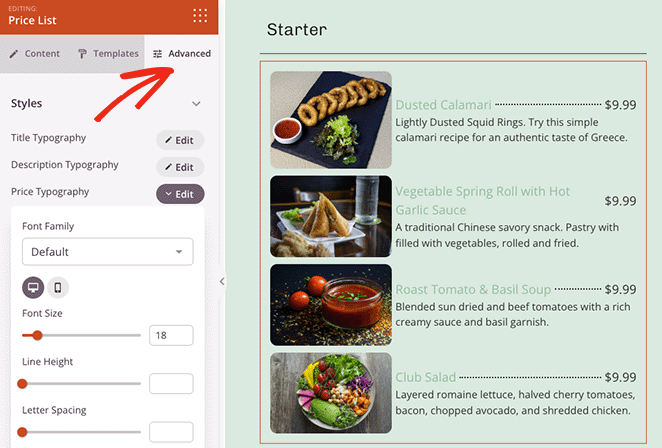
You can also adjust the spacing, borders, background colors, and visibility on desktop and mobile devices. And you won’t need to write custom CSS or HTML.
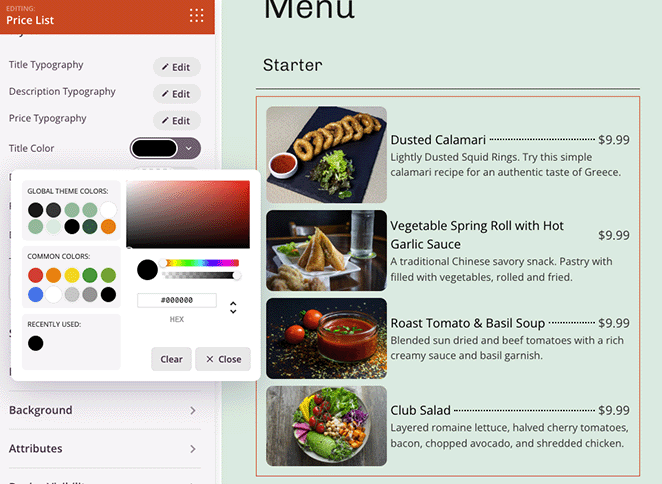
Simply point and click to add new styling.
Once you’re happy with your price list, you can remove the old filler content. To do that, hover over each column until you see a blue outline and click the trashcan icon.
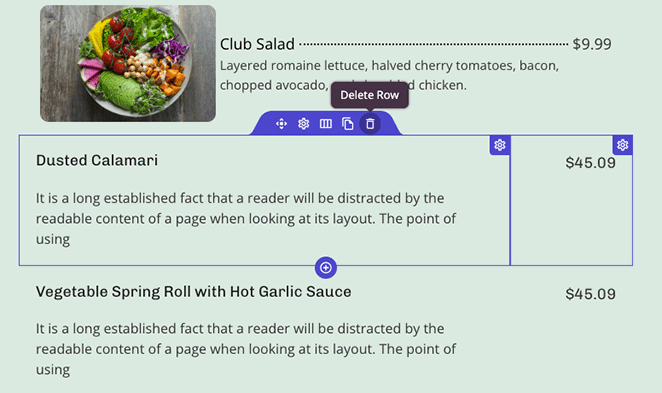
Do that for every element on the page you no longer need. Now go ahead and click the Save button in the upper-right corner of your screen.

Now that your pricing page is complete, you can edit and customize the rest of your WordPress theme.
Here are some handy guides that may help you with your customizations:
- How to Add a Button to Your Website Header
- How to Add Your Business Hours to Your Website
- How to Add Custom Social Icons to Your Website
Step 5. Publish Your Price List Page
When you’ve finished customizing your website, you’re ready to publish the changes on the front end.
First, make sure you’ve saved your changes, then click the X icon to exit the page builder and navigate back to the Theme Builder page in your WordPress dashboard.
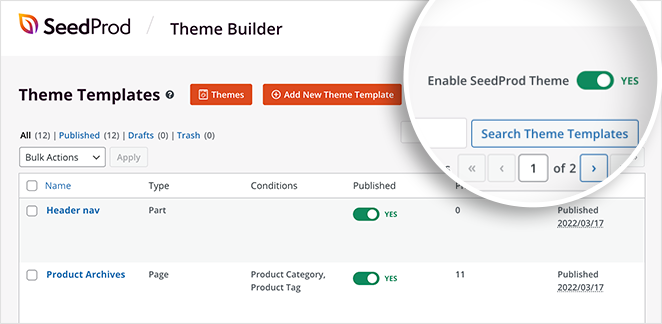
From there, find the toggle that says “Enable SeedProd Theme” and turn it to the Yes position.
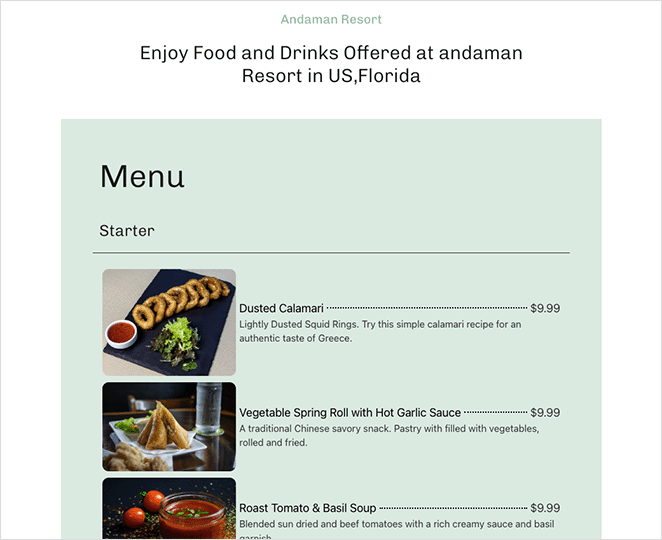
Now you can visit your live website to see how your customizations look. Here’s the Dining page I customized with a new price list in this tutorial. If you want to take things further, our restaurant website guide covers how to build out a full site using the same approach.
How to Make a Pricing Table in WordPress
If you offer tiered plans or packages, a pricing table is the better fit. It puts each plan side by side so visitors can compare features and pick the one that suits them.
SeedProd has a dedicated Pricing Table block for exactly this, and it works in the same drag-and-drop builder. I like starting here because you’re not just dropping in a table, you can build a full pricing section around it with testimonials, a countdown timer, and call-to-action buttons that drive signups.
Here’s how to build one on a landing page. If you haven’t created your page yet, follow our step-by-step guide on creating a landing page with SeedProd, then come back here for the pricing table.
Step 1. Add the Pricing Table Block
Open your page in the SeedProd builder and add a row where you want your table to sit. I picked a premade template and added a row with three columns to house a three-plan table.
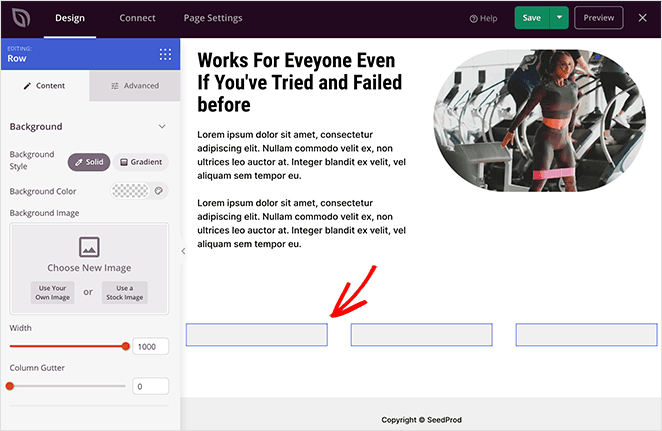
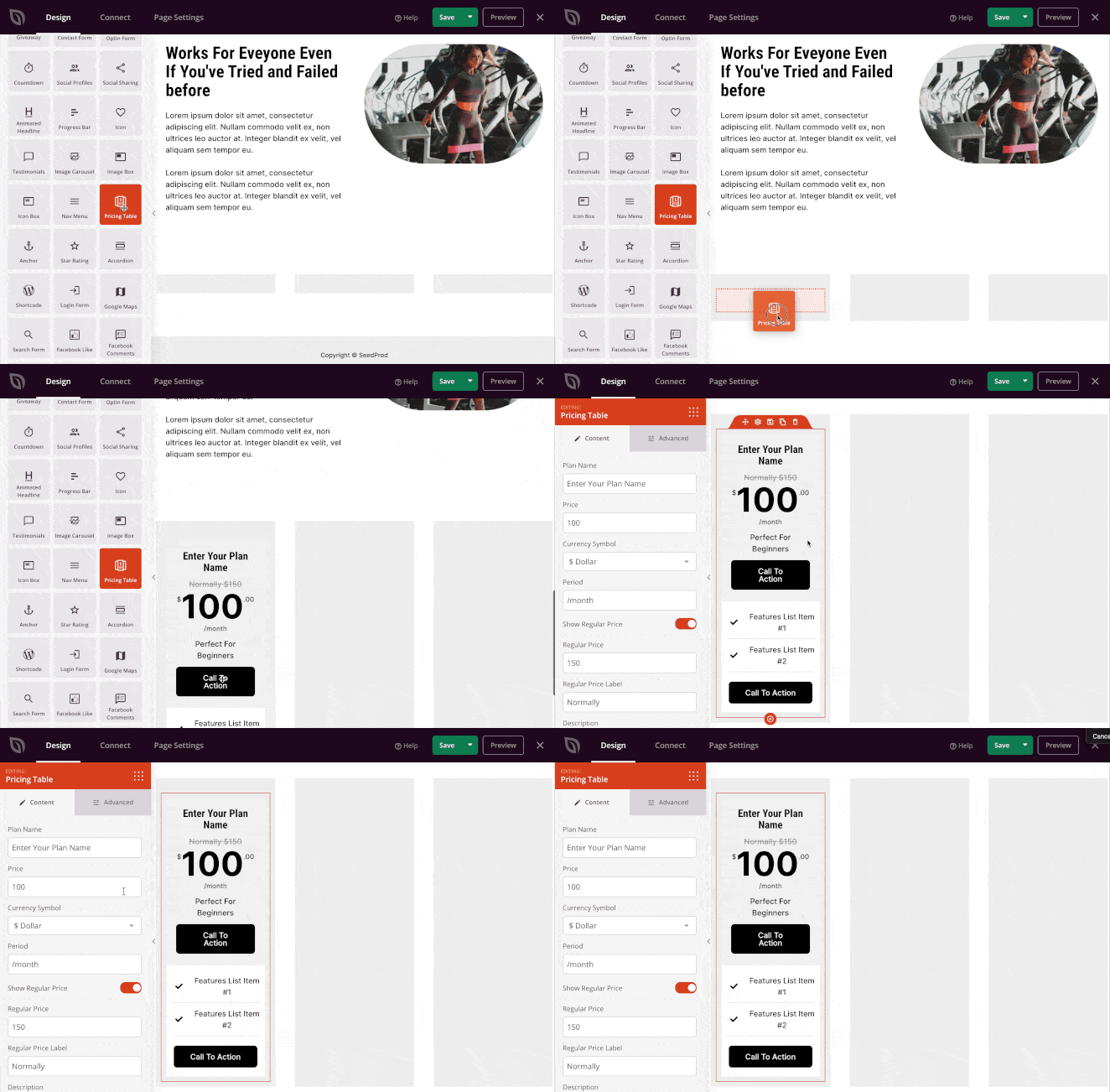
From the block panel, drag the Pricing Table block into the first column. For a three-column table, repeat that two more times so each plan has its own column.
Step 2. Customize Your Plans
Click the settings icon on any table block to edit that plan. Each one has fields for everything a good plan needs.
- Plan name
- Price and currency
- A “regular” price to show a discount
- A short description
- A features list
- One or more CTA buttons
In the Advanced tab, you can change each table’s colors, fonts, icons, spacing, buttons, and hover effects. This is how you make one tier stand out from the others, which nudges shoppers toward the plan you want them to pick.
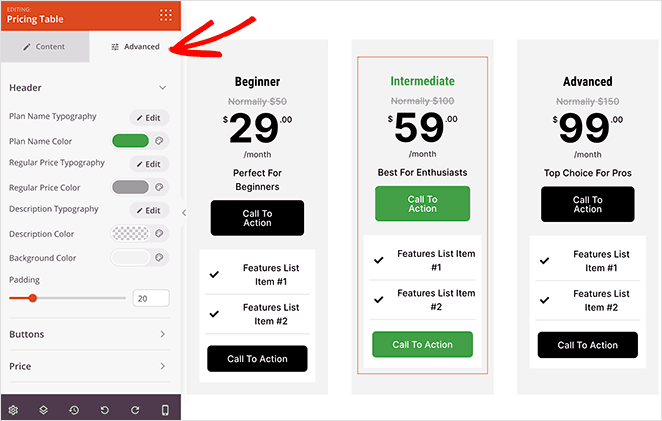
Keep editing until you’re happy with how the tiers look. Then click the Save button to keep your changes.
Step 3. Publish Your Pricing Table
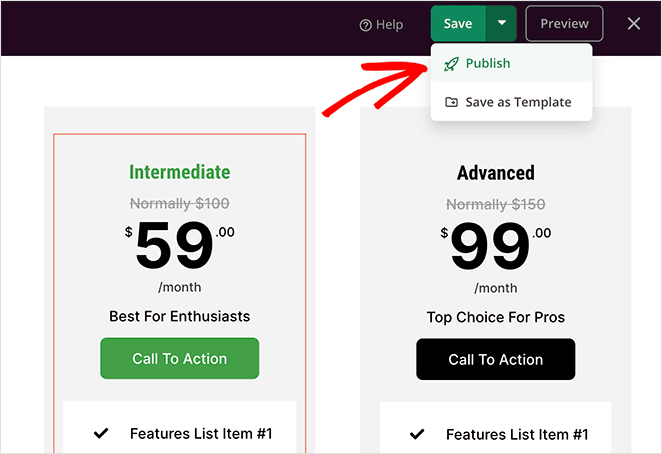
When your table is ready, click the dropdown arrow next to the Save button and choose Publish. That’s all it takes to push the page live.
Click See Live Page to view your finished pricing table, like the three-column example at the top of this guide. Prefer to add a table inside a regular post or page instead of a landing page? A standalone plugin can do that, and our roundup of the best WordPress pricing table plugins walks through the options.
Frequently Asked Questions
What’s the difference between a price list and a pricing table in WordPress?
A price list shows individual services or items with their prices, one entry per row. A pricing table compares multiple plans side by side, often with feature lists and call-to-action buttons.
Use a price list for a restaurant menu or service rates page. Use a pricing table for SaaS products or membership tiers.
What should a price list include?
A price list should include the item name, a short description, and the price. Adding an optional photo and a link to a product or booking page can improve conversions.
SeedProd’s Price List block has dedicated fields for all of these, so you don’t need to build the layout yourself.
How many tiers should my pricing table have?
There’s no single right answer, but three to four tiers works for most businesses. Too few and you lose the upsell, too many and people freeze on the decision.
If you’re unsure, start with three and highlight the middle one as your recommended plan.
What’s the difference between a vertical and horizontal pricing table?
It comes down to orientation. A vertical pricing table stacks each plan’s features down its own column, side by side with the others, which is the layout most people picture.
A horizontal table lays the features out in rows across the plans. Vertical works better on most sites because it reads cleanly on mobile.
Can I add a price list or pricing table to any page on my WordPress site?
Yes. With SeedProd, you can add either one to a dedicated pricing page, a section on your homepage, or a services page. Both blocks work in the Theme Builder and the Landing Page Builder.
That means you’re not limited to one placement, and you can reuse the same block across multiple pages of your site.
Do I need a plugin to add pricing in WordPress?
You don’t need a dedicated plugin, but a tool like SeedProd makes it much faster. It gives you built-in Price List and Pricing Table blocks with layout controls, image options, and typography settings.
Without one, you’d have to build the layout from scratch with HTML or shortcodes, which takes significantly longer.
That’s it!
I hope this article has helped you learn how to add a price list or a pricing table in WordPress.
SeedProd is the best WordPress plugin for customizing your website. You won’t need any extra shortcodes, widgets, or add-ons, just a straightforward, easy-to-use drag-and-drop website builder that gets you up and running quickly.
Ready to add pricing to your WordPress site?
You might also like this review of Elementor vs WPBakery vs SeedProd, so see how they compare.
Thanks for reading! We’d love to hear your thoughts, so please feel free to join the conversation on YouTube, X and Facebook for more helpful advice and content to grow your business.